


IBDP School in Pune
INTERNATIONAL BACCALAUREATE DIPLOMA PROGRAMME (IBDP)
Curriculum
Group 2 Language Acquisition
Group 3 Individuals and Societies
Sciences
Mathematics
The Arts
Essay
Students select one subject from each of these six groups, with the usual DP structure:
- Studies in Language & Literature (e.g., English A: Literature)
- Language Acquisition (e.g., French B, Spanish B, or Language ab initio options)
- Individuals & Societies (e.g., Economics, History, Psychology)
- Sciences (e.g., Biology, Chemistry, Physics, Environmental Systems)
- Mathematics (Analysis & Approaches or Applications & Interpretation)
- The Arts (e.g., Visual Arts, Music) — or a second choice from groups 3 or 4 instead of Arts
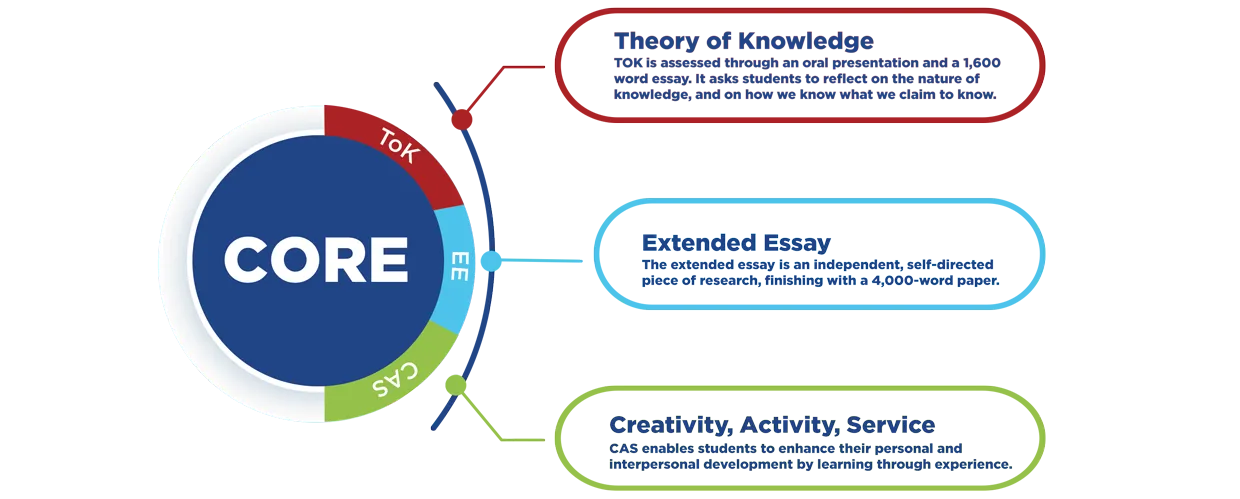
DP Core
- Theory of Knowledge (TOK) — an interdisciplinary course that examines how we know what we claim to know.
- Extended Essay (EE) — a 4,000-word independent research project supervised by a mentor.
- Creativity, Activity, Service (CAS) — sustained, experiential engagements expressing creativity and responsibility as an extension of academic learnings; completion is required for the diploma.
Assessment & Grading
- Six subject grades, each graded 1–7, 1 being the lowest and 7 highest. Up to 3 additional points are awarded for the combined performance in TOK and the EE. The maximum diploma score is thus 42+3=45
- Final assessment is a combination of external examinations ( for most subjects) and internal assessment (IAs) that are moderated externally. External exam marking is done by IB examiners; internal assessments are teacher-marked and externally moderated.
Group 1
Studies in Language and Literature
All three courses in studies in language and literature are designed for students from a wide variety of linguistic and cultural backgrounds, who have experience of using the language of the course in an educational context. The focus of the study developed in each of the subjects varies depending on their individual characteristics.
In this course, students study a wide range of literary and non-literary texts in a variety of media. By examining communicative acts across literary form and textual type alongside appropriate secondary readings, students will investigate the nature of language itself and the ways in which it shapes and is influenced by identity and culture. Approaches to study in the course are meant to be wide ranging and can include literary theory, sociolinguistics, media studies and critical discourse analysis among others.
LITERATURE HL Group 1
This course is designed for the student with a definite inclination towards the study of literature and who may intend to continue such studies beyond the Diploma level. The course focuses on in-depth literary analysis and appreciation in both oral and written capacity. Students will be required to write essays, conduct independent research and participate in informal and formal orals for internal and external assessment. The total number of texts studied over the two years is 13, including 3 World Literature works, which are read in translation.
LITERATURE SL
This course is designed for students who desire some enrichment in the study of literature, but who may not have such a definite inclination towards the study of literature, or who may be considering options for such study beyond the Diploma level. Most of the course is studied along with HL students to the same depth. The courses differ in the numbers of texts covered and the types of assessment. This course will appeal to those who enjoy literary study, but who also wish to pursue other subject areas at HL instead. The total number of texts studied is 10, including 3 World Literature works, which are read in translation.
Group 2
Language Aquisition
Language acquisition consists of two modern language courses—language ab initio and language B—that are offered in a number of languages, and a classical languages course that is offered in Latin and Classical Greek. Owing to the nature of language study in the latter,
there are specific aims for classical literature that can be found in the Classical languages guide. Language ab initio and language B are language acquisition courses designed to provide students with the necessary skills and intercultural understanding to enable them to communicate successfully in an environment where the language studied is spoken. This process allows the learner to go beyond the confines of the classroom, expanding their awareness of the world and fostering respect for cultural diversity.
The two modern language courses—language ab initio and language B—develop students’ linguistic abilities through the development of receptive, productive and interactive skills (as defined in the “Syllabus content” section). The classical languages course focuses on the study of the language, literature and culture of the classical world.
AB INITIO
Language ab initio is a language acquisition course designed for students with no prior experience of the target language, or for those students with very limited previous exposure. It should be noted that language ab initio is offered at SL only.
In order to ensure that the range of language and structures covered in language ab initio classes is manageable for all students, and so that they marry closely with the format and contents of final assessments, language-specific syllabuses have been provided.
At the language ab initio level, a student develops receptive, productive and interactive communicative skills. Students learn to communicate in the target language in familiar and unfamiliar contexts
LANGUAGE B- SL & HL
Language B is a language acquisition course designed for students with some previous experience of the target language.
In the language B course, students further develop their ability to communicate in the target language through the study of language, themes and texts. In doing so, they also develop conceptual understandings of how language works, as appropriate to the level of the course.
Group 3
Individuals and Societies
Group 3 subjects, known as Individuals and Societies, encourage students to explore and understand human behaviour and experience in a range of cultural, economic, environmental, and historical contexts. These subjects develop critical thinking, research, and analytical skills through the study of patterns and processes that shape societies and influence global interactions.
ECONOMICS
Economics is an exciting, dynamic subject that allows students to develop an understanding of the complexities and interdependence of economic activities in a rapidly changing world. At the heart of economic theory is the problem of scarcity. While the world’s population has unlimited needs and wants, there are limited resources to satisfy these needs and wants. As a result of this scarcity, choices must be made. As a social science, economics examines these choices using models and theories.
The Diploma Programme (DP) economics course allows students to explore these models and theories, and apply them, using empirical data.
ECONOMICS SL
At the Standard Level (SL), which has a recommended teaching time of 150 hours, students study four key areas — Introduction to Economics, Microeconomics, Macroeconomics, and Global Economics. They focus on understanding core economic concepts, principles, and theories and learn to apply these to real-life contexts. Students interpret economic data, use basic quantitative techniques, and develop skills in constructing and evaluating simple economic models.
ECONOMICS HL
At the Higher Level (HL), which has a recommended teaching time of 240 hours, students study the same four areas but in greater depth, with an emphasis on advanced analysis and evaluation. HL students apply additional quantitative methods and use more complex models to explore the interconnections between economic variables. They are expected to demonstrate higher-order analytical thinking and develop the ability to assess policy options and provide informed economic advice.
At both levels, students are encouraged to consider multiple perspectives, think critically about real-world issues, and appreciate the global interconnectedness of economic activity and decision-making.
Business Management
The business management course is designed to meet the current and future needs of students who want to develop their knowledge of business content, concepts and tools to assist with business decision-making. Future employees, business leaders, entrepreneurs or social entrepreneurs need to be confident, creative and compassionate as change agents for business in an increasingly interconnected global marketplace. The business management course is designed to encourage the development of these attributes.
Through the exploration of four interdisciplinary concepts—creativity, change, ethics and sustainability—this course empowers students to explore these concepts from a business perspective. Business management focuses on business functions, management processes and decision-making in contemporary contexts of strategic uncertainty.
BUSINESS SL
The business management course encourages the application of local, national and global examples to content and concepts; the internal assessment (IA) for both SL and HL is an individual business research project that allows greater analysis and evaluation of content, concepts and context. Students can develop a deeper understanding of an organization by studying its processes through the lenses of creativity, change, ethics and sustainability.
BUSINESS HL
For the external assessment (paper 1 SL and HL), students will be assessed on their knowledge of important contemporary business topics through their analysis of a fictitious business. Paper 2 (SL and HL) has a greater focus on developing students’ analytical and financial quantitative skills. This will allow students to combine their qualitative writing as business communicators with deeper financial analysis. In paper 3 (HL only) students apply their knowledge of business tools and content through an innovative and potentially disruptive social enterprise. This paper will allow business students to demonstrate their empathetic, creative, analytical and evaluative skills.
Psychology
Psychology is the rigorous and systematic study of mental processes and behaviour. It is a complex subject which draws on concepts, methods and understandings from a number of different disciplines. There is no single approach that would describe or explain mental processes and behaviour on its own as human beings are complex animals, with highly developed frontal lobes, cognitive abilities, involved social structures and cultures. The study of behaviour and mental processes requires a multidisciplinary approach and the use of a variety of research techniques whilst recognising that behaviour is not a static phenomenon, it is adaptive, and as the world, societies and challenges facing societies change, so does behaviour.
At the core of the DP psychology course is an introduction to three different approaches to understanding behaviour:
biological approach to understanding behaviour cognitive approach to understanding behaviour sociocultural approach to understanding behaviour
PSYCHOLOGY SL
SL students are required to study one option (see topics in HL section) while HL students study two options. This differentiation is reflected in paper 2 of the external assessment.
Both SL and HL students will be expected to show their understanding of approaches to research in the internal assessment and for criterion D (critical thinking) in paper 1 section B and paper 2 responses.
PSYCHOLOGY HL
The following extensions to the core approaches are studied at HL only.
- The role of animal research in understanding human behaviour
- Cognitive processing in a technological (digital/modern) world
- The influence of globalization on individual behaviour
HL students will be directly assessed on their understanding of approaches to researchin paper 3 of the external assessment. This will cover both qualitative and quantitative research methods.
Group 4
Sciences
Physics
Physics is the study of nature and the universe itself — from the Big Bang to the mysteries of time and matter. It has led to some of the greatest discoveries that continue to shape our world today. Once focused on observing the stars and atoms, physics now spans from exploring black holes to developing everyday technologies. It underpins advances in communication, medicine, and renewable energy. Above all, physics is a creative and curious pursuit — a constant quest to understand and innovate.
The structure of this physics syllabus is intended to promote concept-based learning and teaching that can be connected through three concepts: energy, particles and forces.
The aim of the syllabus is to integrate concepts, topic content and the nature of science through inquiry. Students and teachers are encouraged to personalize their approach to the syllabus according to their circumstances and interests. Skills in the study of physics should be integrated into the teaching of the syllabus content
PHYSICS SL
The SL course provides students with a fundamental understanding of physics and experience of the associated skills. An understanding of science through a stimulating experimental programme:
- The nature of science as an overarching theme
- The study of a concept-based syllabus
- One piece of internally assessed work, the scientific investigation
- The collaborative sciences project
PHYSICS HL
The HL course requires students to increase their knowledge and understanding of the subject, and so provides a solid foundation for further study at university level. Some of the HL content is conceptually more demanding and explored in greater depth. The increased breadth and depth at HL result in increased networked knowledge, requiring the student to make more connections between diverse areas of the syllabus
Environmental Systems and Sciences
Environmental systems and societies (ESS) is a dynamic interdisciplinary subject that takes 21st-century challenges and socio-environmental real-world issues and looks at them through the lens of human societies and the interrelationships of the natural world: biosphere, atmosphere, hydrosphere and lithosphere. Students explore how these relationships change over time and space, consider the potential adaptations and mitigations that human societies and the natural world may currently be undergoing, and how these could impact the future and our place in it.
Environmental Systems and Societies (ESS) is an interdisciplinary course available at both standard level (SL) and higher level (HL), integrating methodologies, techniques, and knowledge from the sciences and individuals and societies subject groups. Students can take ESS within either or both groups, and if studied in both, they may also choose an additional subject from any group, including sciences or individuals and societies.
ESS SL
Environmental systems and societies (ESS) is an interdisciplinary course offered only at standard level (SL). The SL course gives students a solid introduction to ESS and helps them develop essential skills and understanding of the subject.
ESS HL
the HL course builds on this foundation, asking students to examine environmental issues more deeply through ethical, legal, and economic perspectives (known as HL lenses). It also prepares them well for university-level study. Both levels enable students to grasp the complexity of environmental challenges and explore ways to manage and resolve them.
HL students are expected to demonstrate greater critical thinking, applying both SL and HL content—as well as HL lenses—to examine environmental problems in more depth and from multiple perspectives.
Biology
The scale of life in biology ranges from the molecules and cells of organisms to ecosystems and the biosphere. This way of considering complex systems as simpler components—an approach known as reductionism—makes systems more manageable to study. It is the foundation of controlled experiments and has thus enabled major discoveries, but it provides an incomplete view of life. At each level of biological organization, different properties exist. Living systems are based on interactions, interdependence and integration of components between all levels of biological organization.
A student of biology should gain not only a conceptual understanding of the subject, but also an awareness of how biologists construct knowledge claims and the limitations of these methods.
BIOLOGY SL
The SL course provides students with a fundamental understanding of biology and experience of the associated skills.
Students at SL and HL share the following.
- An understanding of science through a stimulating experimental programme The nature of science as an overarching theme
- The study of a concept-based syllabus
- One piece of internally assessed work, the scientific investigation The collaborative sciences project
BIOLOGY HL
The HL course requires students to increase their knowledge and understanding of the subject, and so provides a solid foundation for further study at university level.
Some of the HL content is conceptually more demanding and explored in greater depth. The increased breadth and depth at HL result in increased networked knowledge, requiring the student to make more connections between diverse areas of the syllabus.
Computer Science
Computer science is the study of computers and computational systems. It covers a range of topics related to the theoretical aspects of computing, including algorithms and software design, and the application of computer science to solve practical problems. Computer science is distinct from the natural sciences in that it does not rely on hypothesis and experimentation. Computer science can be considered to be cross- disciplinary, as it draws from a range of disciplines, especially mathematics.
In the DP computer science course, students develop computational thinking, a problem-solving technique that can be applied to everyday challenges. Computational thinking is a crucial skill set in the modern digital age, allowing us to tackle problems by leveraging the power of computer processes. This will develop students’ understanding of this concept and develop their ability to apply it
COMPUTER SCIENCE SL
Students at both SL and HL study the following parts of the course.
- The nature of computer science, with computational thinking as an organizing concept
- An understanding of computer science through the practical use of a programming language (Java or Python), and the object-oriented programming (OOP) paradigm
- The application of Structured Query Language (SQL) to extract and manipulate data
- One IA task: The computational solution
- A case study focusing on emerging technologies
- The collaborative sciences project
The SL and HL courses both provide students with an understanding of computer science through the organizing concept of computational thinking and the practical use of skills in computer science to solve problems.
COMPUTER SCIENCE HL
- HL students study an extra topic (abstract data types) with additional HL-only material within the seven SL topics.
- HL students study the topics to increased breadth, resulting in increased networked knowledge. HL requires the student to make more connections between diverse areas of the syllabus, thereby also increasing the depth of coverage.
- HL students also conduct deeper research in the case study, reflected in the extra two challenge questions in the case study for HL, additional recommended teaching hours, and additional time for paper 1.
The HL course provides a solid foundation for the study of computer science or related subjects at university level.
Chemistry
As one of the three natural sciences in the IB Diploma Programme, chemistry is primarily concerned with identifying patterns that allow us to explain matter at the microscopic level. This then allows us to predict and control matter’s behaviour at a macroscopic level. The subject therefore emphasizes the development of representative models and explanatory theories, both of which rely heavily on creative but rational thinking. Given the pattern-seeking nature of chemistry, the development of generalized rules and principles also plays an important part in knowledge production, as do the concrete statements provided by mathematical laws.
The Diploma Programme chemistry course supports teaching through:
- approaches to learning nature of science
- nature of science
- skills in the study of chemistry.
CHEMISTRY SL
The SL course provides students with a fundamental understanding of chemistry and experience of the associated skills.
The distinction between SL and HL is therefore one of both breadth and depth.
CHEMISTRY HL
The HL course requires students to increase their knowledge and understanding of the subject, including additional mathematical skills, and so provides a solid foundation for further study at university level.
Some of the HL content is conceptually more demanding and explored in greater depth. The increased breadth and depth at HL result in increased networked knowledge, requiring the student to make more connections between diverse areas of the syllabus.
Group 5
Mathematics
Mathematics has been described as the study of structure, order and relation that has evolved from the practices of counting, measuring and describing objects. Mathematics provides a unique language to describe, explore and communicate the nature of the world we live in as well as being a constantly building body of knowledge and truth in itself that is distinctive in its certainty. These two aspects of mathematics, a discipline that is studied for its intrinsic pleasure and a means to explore and understand the world we live in, are both separate yet closely linked.
The two mathematics courses available to Diploma Programme (DP) students express both the differences that exist in mathematics described above and the connections between them. These two courses might approach mathematics from different perspectives, but they are connected by the same mathematical body of knowledge, ways of thinking and approaches to problems. The differences in the courses may also be related to the types of tools, for instance technology, that are used to solve abstract or practical problems. The next section will describe in more detail the two available courses
Mathematics : Analysis and Approaches
It is for students who enjoy developing their mathematics to become fluent in the construction of mathematical arguments and develop strong skills in mathematical thinking. They will also be fascinated by exploring real and abstract applications of these ideas, with and without technology. Students who take Mathematics: analysis and approaches will be those who enjoy the thrill of mathematical problem solving and generalization.
Mathematics : Application and Interpretation
It is for students who are interested in developing their mathematics for describing our world and solving practical problems. They will also be interested in harnessing the power of technology alongside exploring mathematical models. Students who take Mathematics:
applications and interpretation will be those who enjoy mathematics best when seen in a practical context.
Group 6
The Arts
IB Visual Arts is a practice-based course that encourages students to engage in creative processes through art-making as inquiry. Students explore a range of art- making forms, media, and ideas while developing technical competence, conceptual understanding, and personal expression. They connect their own creative practice with cultural, historical, and contemporary contexts, fostering a broader understanding of art as a global language.
The course is structured around three core areas:
- Create – generating, developing, and resolving ideas through practical art-making.
- Connect – situating art and the artist in context; exploring relationships between
artist, artwork, audience, and culture. - Communicate – curating, presenting, and reflecting on artworks and artistic intentions.
ARTS SL
The SL Visual Arts course encourages exploration and experimentation across a range of media and ideas. Students investigate artistic techniques, contexts, and processes to develop an understanding of how meaning is constructed through art. The focus is on building creative confidence, technical skill, and reflective awareness. SL students curate a selection of resolved artworks that demonstrate their growth as emerging artists. Assessment at this level values breadth of exploration, evidence of process, and the ability to articulate artistic intentions clearly.
ARTS HL
The HL Visual Arts course allows students to engage deeply in artistic inquiry, experimentation, and reflection. They develop a body of resolved artworks that demonstrate personal meaning, technical refinement, and conceptual depth. HL students critically analyze artistic influences, make interdisciplinary connections, and curate their final exhibition with a strong sense of context and intention. Emphasis is placed on the development of a distinctive artistic voice through sustained studio practice and comprehensive research. HL assessment values depth, synthesis, and the ability to communicate complex ideas visually and verbally.
Creativity, Activity, Service
CAS encourages students to become active, compassionate, lifelong learners. Through CAS experiences, a student’s exposure to particular global issues at a local level may give rise to an interest in furthering their understanding of these issues through academic research. CAS continues to develop students’ ability to engage in critical reflection, offering increasingly sophisticated opportunities for students to analyse their own thinking, effort and performance. Students also learn how to set challenging goals and develop the commitment and perseverance to achieve them.
It provides a framework for experiential learning beyond academics, balancing Creativity (C), Activity (A), and Service (S).
Through CAS, students:
- Discover their interests and strengths.
- Learn to plan, act, and reflect purposefully.
- Build empathy, resilience, and global awareness.
- Develop collaboration, leadership, and ethical decision-making.
CAS is not about counting hours — it’s about growth, balance, and meaning.
CREATIVITY
Engages the mind through imaginative thinking and original expression. This strand encourages exploration of ideas leading to an outcome that is innovative or expressive.
Examples:
- Designing an art exhibit or fashion upcycling project
- Writing and producing a short film or podcast
- Organizing a cultural event, sustainability campaign, or theatre performance.
Focus: Thinking creatively, developing artistic or problem-solving skills,
and expressing personal vision.
ACTIVITY
Involves physical exertion that contributes to a healthy and balanced lifestyle. It encourages students to step out of their comfort zones, build discipline, and explore wellness through physical experiences.
Examples:
- Training for a sport or marathon
- Participating in yoga, trekking, or dance sessions
Focus: Building perseverance, resilience, and an awareness of body–
mind connection.
SERVICE
Engages students in voluntary, meaningful actions that benefit others and the community. Service activities are based on genuine needs, mutual respect, and collaboration — they foster empathy, civic responsibility, and ethical awareness.
Examples:
- Conducting environmental clean-ups or awareness drives
- Tutoring underprivileged children
- Partnering with NGOs on community initiatives
Focus: Acting with compassion, developing intercultural understanding,
and addressing local or global issues.
Extended Essay
The extended essay is an in-depth study of a focused topic, undertaken either through a subject focused approach or an inter-disciplinary approach combining two DP subjects. Students choose from the list of available DP subjects for the examination session in question. This is normally one of the student’s six selected subjects (or two in the case of the interdisciplinary pathway) for those taking the IB diploma, or a subject that a course student has a background in.
Students must attend three reflection sessions with their supervisor. The third session is a short, concluding interview, or viva voce, that follows the completion of their extended essay.
INTERDISCIPLINARY PATHWAY
You research and write your extended essay in an interdisciplinary way when you integrate knowledge, concepts, theories, perspectives or methods, or a combination of these, from two chosen DP subjects. In other words, elements of the two subjects are combined so that they work together effectively to help research an extended essay topic. Ultimately, integration of two subjects can lead to fresh insights and create new and/or deeper understandings that would not be possible through research within one DP subject alone.
SUBJECT FOCUSED PATHWAY
You are researching and writing your extended essay in a subject-focused way when you use knowledge, concepts, theories, perspectives or methods, or a combination of these, from one chosen DP subject to respond to a research question. You are then building on an understanding of this subject that you have developed during your DP studies. It is important to think about your extended essay as being a different experience compared with your classroom learning. This is your opportunity to engage in self-designed, independent research, challenging yourself, expanding your thinking and stretching boundaries.
Theory of Knowledge
In TOK, students reflect on the knowledge, beliefs and opinions that they have built up from their years of academic studies and their lives outside the classroom. The course is intended to be challenging and thought-provoking—as well as empowering —for students. The course centers on the exploration of knowledge questions, which are a key tool for both teachers and students.
The TOK curriculum is made up of three deeply interconnected parts :
The core theme : Knowledge and the knower: This theme encourages students to reflect on themselves as knowers and thinkers, and to consider the different communities of knowers to which we belong.
Optional themes : This element provides an opportunity to take a more in-depth look at two themes of particular interest to teachers and students. The given themes all have a significant impact on the world today and play a key role in shaping people’s perspectives and identities. Teachers select two optional themes from a choice of five: knowledge and technology; knowledge and language; knowledge and politics; knowledge and religion; and knowledge and indigenous societies.
Areas of knowledge : The areas of knowledge (AOK) are specific branches of knowledge, each of which can be seen to have a distinct nature and sometimes use different methods of gaining knowledge. In TOK, students explore five compulsory areas of knowledge: history; the human sciences; the natural sciences; mathematics; and the arts.
EORY OF KNOWLEDGE : EXHIBITION
The TOK exhibition assesses the ability of the student to show how TOK manifests in the world around us. The exhibition is an internal assessment component; it is marked by the teacher and is externally moderated by the IB.
THEORY OF KNOWLEDGE : ESSAY
The TOK essay engages students in a more formal and sustained piece of writing in response to a title focused on the areas of knowledge. The essay is an external assessment component; it is marked by IB examiners. The essay must be a maximum of 1,600 words and must be on one of the six prescribed titles issued by the IB for each examination session.